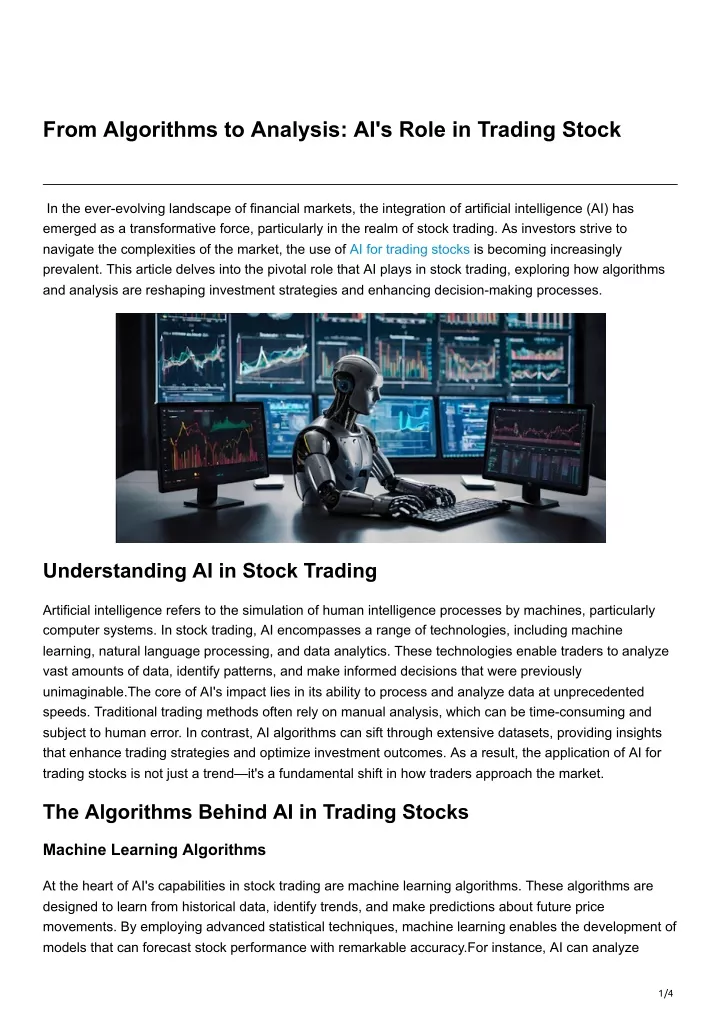
Top 10 Suggestions For Considering Ai And Machine Learning Models On Ai Stock Trading Platforms
To ensure accurate, reliable, practical insights, it’s essential to assess the AI and machine-learning (ML), models used by trading and prediction platforms. Models that are overhyped or poorly constructed could result in inaccurate predictions or even financial losses. Here are our top 10 tips on how to evaluate AI/ML-based platforms.
1. The model’s design and its purpose
It is crucial to determine the goal. Find out if the model has been developed to allow for long-term investments or short-term trading.
Algorithm transparency – Look for any disclosures about the algorithms (e.g. decision trees or neural nets, reinforcement learning, etc.).
Customizability: Find out if the model can adapt to your particular trading strategy or tolerance for risk.
2. Measure model performance metrics
Accuracy: Test the accuracy of the model in the prediction of future events. However, do not solely depend on this measurement because it could be misleading when used with financial markets.
Recall and precision (or accuracy) Find out how well your model is able to differentiate between genuine positives – e.g. accurate predictions of price movements as well as false positives.
Risk-adjusted returns: See whether a model’s predictions result in profitable trades when risk is taken into account (e.g. Sharpe or Sortino ratio).
3. Test the Model by Backtesting it
Historical performance: Use the previous data to test the model and assess how it would have performed under past market conditions.
Testing with data that is not the sample: This is essential to avoid overfitting.
Scenario-based analysis: This entails testing the accuracy of the model under different market conditions.
4. Be sure to check for any overfitting
Overfitting signals: Look out for models performing extraordinarily well with data training but poorly on data that is not seen.
Methods for regularization: Make sure that the platform does not overfit when using regularization methods such as L1/L2 or dropout.
Cross-validation (cross-validation): Make sure your platform uses cross-validation to evaluate the model’s generalizability.
5. Examine Feature Engineering
Relevant features: Check if the model uses meaningful features (e.g. price, volume, technical indicators, sentiment data macroeconomic factors, etc.).
Selecting features: Ensure that the system chooses characteristics that have statistical significance and avoid redundant or irrelevant information.
Updates to dynamic features: Check that the model can be adapted to changes in features or market conditions over time.
6. Evaluate Model Explainability
Interpretability: The model needs to be able to provide clear explanations for its predictions.
Black-box models cannot be explained Be wary of software that use complex models including deep neural networks.
User-friendly insights: Check if the platform provides actionable insights in a format that traders are able to comprehend and apply.
7. Test the ability to adapt your model
Market shifts: Determine whether the model is able to adapt to changing market conditions (e.g., changes in regulations, economic shifts, or black swan-related instances).
Check for continuous learning. The platform should be updated the model frequently with new data.
Feedback loops: Ensure that the platform incorporates user feedback or actual results to improve the model.
8. Check for Bias or Fairness.
Data biases: Check that the training data are accurate and free of biases.
Model bias: Make sure that the platform is actively monitoring biases in models and minimizes them.
Fairness. Check that your model doesn’t unfairly favor specific industries, stocks or trading strategies.
9. Examine the computational efficiency
Speed: Check whether the model produces predictions in real time with the least latency.
Scalability: Check whether a platform is able to handle several users and massive databases without affecting performance.
Resource usage : Check whether the model is optimized to make use of computational resources effectively (e.g. GPU/TPU).
Review Transparency, Accountability, and Other Questions
Documentation of the model: Ensure that the platform has detailed documentation on the model’s design and its the training process.
Third-party audits : Verify if your model has been validated and audited independently by third parties.
Error Handling: Determine if the platform is equipped with mechanisms that detect and correct errors in the models or in failures.
Bonus Tips:
Case studies and reviews of users Review feedback from users as well as case studies in order to assess the performance of the model in real-life situations.
Trial period: You may use the demo, trial, or a free trial to test the model’s predictions and its usability.
Support for customers – Make sure that the platform you choose to use is able to provide robust support to solve problems related to model or technical issues.
The following tips can assist you in assessing the AI models and ML models that are available on stock prediction platforms. You will be able to determine whether they are trustworthy and trustworthy. They must also align with your trading objectives. See the recommended go here for best ai trading app for website examples including market ai, stock ai, ai for investment, AI stock market, ai trade, ai trading tools, ai investing, best AI stock trading bot free, ai investing platform, chatgpt copyright and more.
Top 10 Tips On Risk Management Of Ai Trading Platforms That Forecast Or Analyze Stock Prices
A platform for trading that makes use of AI to analyze and predict stocks should have a robust risk management system. This will safeguard your investment capital and reduce any possible losses. Platforms with strong risk management features can help you navigate turbulent stock markets and make an the right decision. Here are ten top tips to help you assess the risk management capabilities of these platforms.
1. Study Stop-Loss Features and Take Profit features
Customizable level: You should be able customize the take-profit/stop-loss levels of your the individual strategies and trades.
Find out if you can utilize trailing stops. They automatically adjust as the market shifts in your favor.
Stop-loss guarantee: Check to find out if the platform offers stop-loss guarantee, which will guarantee that your account will close at a certain price in even volatile markets.
2. Utilize Position Sizing Tools
Fixed amount: Make sure that the platform you are using allows you to adjust position sizes according to a fixed amount.
Percentage: Check whether you are able to determine your positions’ sizes in percentages of the total value of your portfolio. This will allow you to manage risk in a proportional way.
Risk-reward: Make sure your platform allows you to determine risk-rewards for each trade or strategy.
3. Check for Diversification Assistance
Multi-assets trading: Make sure that the platform is able to support trading across different asset categories (e.g. ETFs, stocks, options, forex, etc.) to diversify your portfolio.
Sector allocation: See whether the platform has tools to monitor and manage the exposure of sectors.
Geographic diversification: Check if the trading platform has international markets available in order to spread risk geographically.
4. Evaluation of Leverage and Margin controls
Margin requirements: Make sure the platform discloses clearly any limitations on margins when trading leveraged.
Make sure your platform lets you to limit leverage to manage the risk of exposure.
Margin calls: Make sure you receive prompt notifications from the platform in order to prevent account liquidation.
5. Assessment of Risk Analytics and Reporting
Risk metrics – Check that your platform contains key risk metrics such as the Sharpe ratio (or Value at Risk (VaR)), or drawdown (or value of portfolio).
Scenario Analysis: Check the platform you use allows the ability to simulate various market scenarios in order to assess possible risks.
Performance reports: Find out whether the platform provides comprehensive performance reports, which include the risk-adjusted return.
6. Check for Real-Time Risk Monitoring
Monitoring your portfolio: Make sure that the platform provides real-time tracking of your portfolio risk exposure.
Notifications and alerts: Verify whether the platform offers real-time alerts for events that are risky (e.g. Margin breaches, stop-loss triggers).
Risk dashboards: Ensure the platform provides an adjustable risk dashboard that gives you a full picture of your personal profile.
7. Test Stress Testing and backtesting
Stress testing: Make sure the platform you choose permits the testing of your portfolio and strategies in extreme market conditions.
Backtesting: Determine whether the platform allows backtesting of strategies using old data to gauge the risk and effectiveness.
Monte Carlo simulators: Verify that the software is using Monte Carlo to simulate a range of outcomes that could occur to allow you to assess risks.
8. Risk Management Regulations Compliance Assessment
Compliance with the regulatory requirements: Ensure that the platform is compliant with the applicable risk management regulations in Europe as well as the U.S. (e.g. MiFID II).
Best execution: Check to determine if your platform is following the most efficient execution methods. This guarantees that trades are executed at the most efficient price, minimizing the chance of the chance of slippage.
Transparency. Check that the platform is clear and clear about risks.
9. Examine the parameters of risk that are user-controlled.
Custom risk rules – Be sure the platform permits for you to define your own risk management rules.
Automated risk control: Ensure that the platform implements the rules of risk management automatically, based on the pre-defined guidelines.
Manual overrides See for the possibility of manually overriding the risk control system that is automated in a situation of emergency.
Reviews of User Feedback and Case Studies
User reviews: Conduct research to assess the platform’s effectiveness for risk management.
Case studies: Look for case studies or testimonials highlighting the risk management capabilities of the platform.
Community forums: Find out whether the platform hosts an active user community in which traders share risk management tips and strategies.
Bonus Tips
Free Trial: Test the platform’s features to manage risk in real-world scenarios.
Customer support: Ensure you have a reliable support system regarding risk management related problems or queries.
Check for educational resources.
By following these tips you can evaluate the capability of AI platforms for stock prediction and analysis to manage the risk. This will ensure you choose a platform that safeguards your investment and reduces any losses that could occur. It is vital to have robust risk-management tools to be able to navigate the volatile markets. Check out the most popular read this for blog info including ai options, invest ai, ai software stocks, ai trading tool, ai trading tool, ai in stock market, AI stock prediction, chart ai trading, best stock prediction website, chart ai trading and more.